Albert Gendron
Needful ThingsAlbert Gendron is a Castle Rock dentist whose slow temper becomes a force of physical violence as Leland Gaunt’s provocations turn religious rivalry into a town-wide crisis. First glimpsed amid the paperwork of Danforth Keeton’s concealed financial misconduct, Gendron later emerges as a Catholic organizer and a formidable participant in the street fighting: a figure whose careful deliberation and explosive force make the riot’s transformation from argument to bodily harm unmistakable.
Identity and Early Appearance
Gendron is identified as a dentist and described as ponderous, slow to anger, and slow to recover once anger has taken hold. That disposition shapes his two principal appearances in the story: at first he is an observer in the Municipal Building, then he becomes an active presence in the conflict between Castle Rock’s Catholics and Baptists.
At a quarter to six one morning, Danforth Keeton arrives at the Municipal Building and climbs to the second floor while Gendron, broom in hand and a Chesterfield in his mouth, watches him. A solid-gold Saint Christopher medal Gendron bought at Needful Things is hidden beneath his blue chambray shirt. The two men exchange no words. Gendron has become accustomed to Keeton’s odd-hour visits; Keeton, for his part, has ceased to notice him. The silent scene places Gendron at the edge of a financial secret without suggesting that he knows what Keeton is doing.
Keeton’s Financial Crisis
The papers Keeton sorts in the office include correspondence from the Bureau of Taxation and his own replies, stored in a locked filing-cabinet drawer. Although the letters bear the initials of Keeton and his secretary, Shirley Laurence, she typed none of his responses. The state’s impending audit reaches across the town’s accounts: tax records, revenue-sharing, expenses, road maintenance, law-enforcement and parks budgets, and records for the state-funded experimental tree farm. Gendron’s brief presence in this setting links him to the civic world in which the scandal is unfolding, but the evidence does not make him a participant in Keeton’s embezzlement or its concealment.
Keeton’s private gambling losses explain the financial danger behind that paper trail. After an early win, he celebrates at the track, loses $160, returns to try to recover it, and then loses another $210. To cover the resulting hole in his checking account before his wife notices, he takes $100 from the town’s petty-cash fund. By the autumn of 1990, the accounting concealment is coming apart; Keeton has found a bookie and increased his bets, without improving his luck. Later, one of the slips that intensifies his persecution fear displays the word “EMBEZZLEMENT.” These details distinguish an actual financial offense from the suspicions and accusations that will later inflame the town.
Religious Conflict and Mobilization
The conflict that brings Gendron forward begins with the dispute over Casino Nite. Reverend William Rose mobilizes Baptist opposition through a letter-writing campaign and “DICE AND THE DEVIL” posters; Betsy Vigue organizes the Catholic countercampaign. The Castle Rock Call expands to sixteen pages to accommodate a debate that has become more shouting match than exchange of arguments. Posters are repeatedly put up and torn down, while an editorial urging restraint is ignored.
The deception grows more personal when Gendron brings Father John Brigham a letter taped to the door of his dental office. The obscene note purports to come from a Baptist men’s organization and attacks Brigham. Gendron reacts with anger, denouncing the accusation to Brigham; his response shows how a fabricated provocation can convert a general church dispute into a perceived insult against a particular community. Rose, too, receives a forged obscene note, this one supposedly from Catholic men, and Brigham recounts both letters when he calls a meeting about religious repression in Castle Rock.
The turnout is large enough that the gathering must move from the rectory to the Knights of Columbus Hall. When Brigham proposes that the men meet at the hall while Casino Nite is taking place, Gendron slowly rises to his full height and asks whether the Baptist men might bother the women. Brigham denies that this is his suggestion and frames the meeting as preparation to ensure the event goes smoothly. Gendron’s question registers the fear and suspicion that have begun to overtake the dispute: protection is being discussed before any immediate attack has occurred.
Riot and Physical Violence
During the later confrontation, Gendron is with the Catholic men inside the Knights of Columbus Hall. They have formed a loose circle around him as he tells stories of Catholic-baiting and revenge in Lewiston in the 1930s. He begins one account of an insult to a statue of the Virgin Mary, then breaks off to listen. The gathering’s storytelling and communal memory give way to immediate danger when stink bombs and the sounds outside throw the hall into panic.
Someone cries that the Baptists are attacking. The foyer door has been propped shut with a crowbar, and the men begin to pile against it. Father Brigham finds an unlocked side door and calls for the crowd to follow him, but panic initially keeps the men pressed against the immovable front entrance. Gendron then knocks two men’s heads together and roars for them to do as the priest says, warning that the women are being killed. He forces his way back through the crush, and the others follow in a stumbling line through the foul murk, coughing and cursing. The contrast is stark: the same man who had stood to ask whether the women might be at risk now uses violence to redirect the crowd toward an escape.
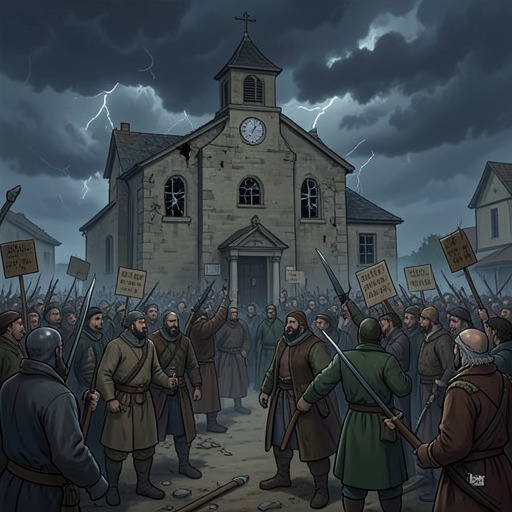
The escape does not end the violence. Near the foot of Castle Hill, the Baptists and Catholics meet in a brawl with no restraint, where people gouge and strike and seem ready to kill. Gendron grabs Norman Harper by the ears and smashes his head against his own; Harper goes limp, and Gendron throws him aside. He then goes for Bill Sayers, a Western Auto tool salesman. When Sayers dodges and punches him, Gendron takes the blow, spits out a tooth, seizes Sayers in a bear hug, and squeezes until a rib breaks. He throws Sayers across the street, where a state trooper nearly runs him down.
Character and Narrative Significance
Gendron’s arc is compressed but consequential. The narrative first gives him the stillness of a man sweeping while Keeton handles hidden papers; later, it places him in a charged public gathering where forged correspondence, religious loyalty, and fear are turning into action. At the hall, he acts decisively to break a deadly crush and get the men moving. In the street, however, the same force is no longer directed toward escape or protection: it becomes an instrument of injury.
That reversal makes Gendron more than a witness to Castle Rock’s disorder. His slow anger does not prevent violence once the town’s competing fears take command; instead, his physical strength gives those fears an especially damaging expression. The forged letter found at his office helps show how Gaunt’s manipulation works through manufactured evidence and existing divisions, but it does not erase Gendron’s own actions. His rescue effort and his brutality occur within the same collapse of judgment, revealing how quickly a defensive gathering can become an assault.